
-

Survey No. 270A & Plot No. 1 of Survey No. 267, Chhatha Mile, Vill: Dantali – 387350 Ta: Vaso, Dist: Kheda, Gujarat (India)
-

Survey No. 270A & Plot No. 1 of Survey No. 267, Chhatha Mile, Vill: Dantali – 387350 Ta: Vaso, Dist: Kheda, Gujarat (India)
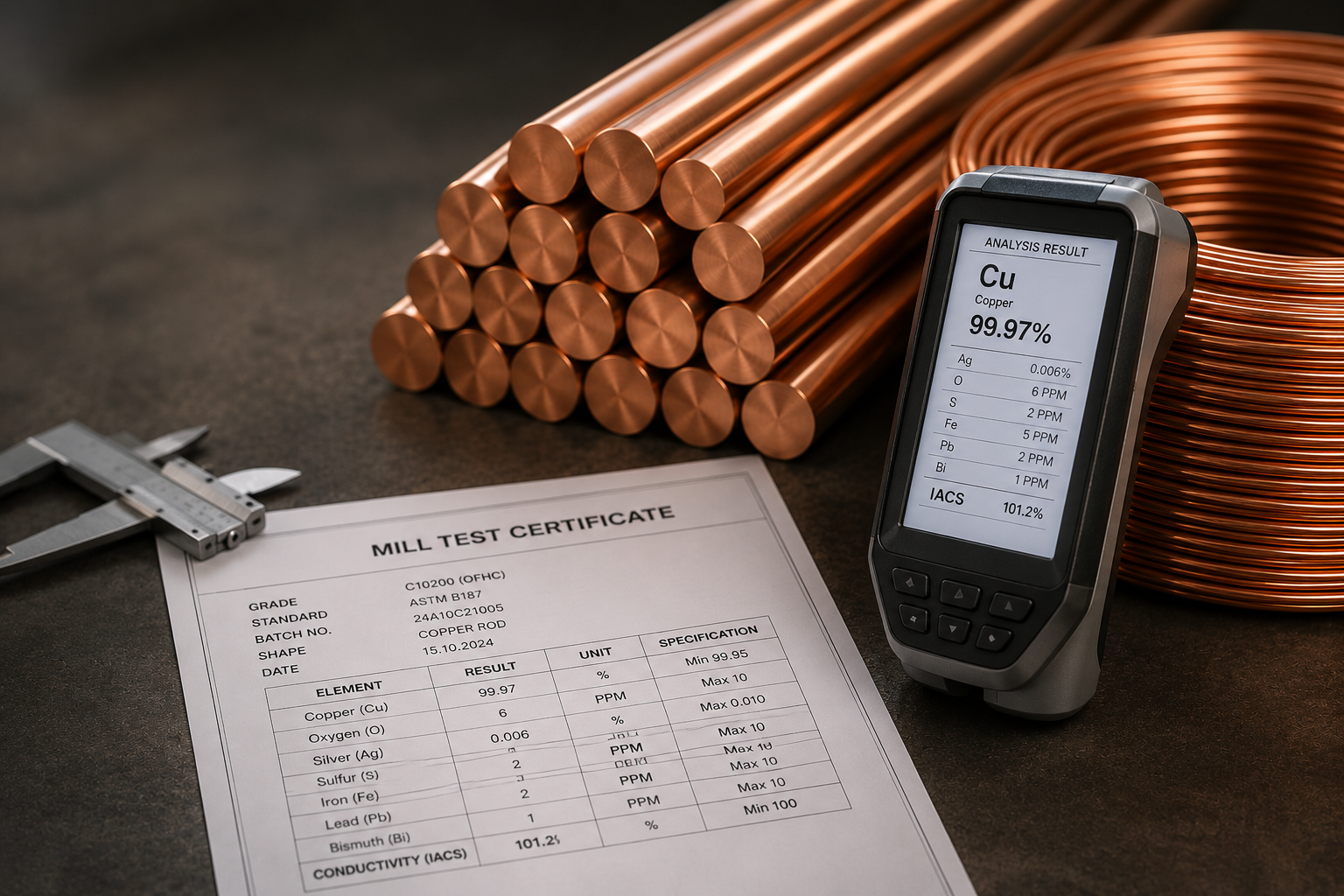
A procurement manager at a transformer manufacturing unit once told us about an order that looked perfect on paper. The invoice said 99.95% pure copper. The rods arrived on time, the packaging was clean, the paperwork was in order. Three weeks later, half the batch failed conductivity testing on the shop floor. The transformer coils were running hotter than expected, and nobody could figure out why until someone finally ran the rods through a spectrometer.
That’s the thing about copper purity — you genuinely cannot tell by looking at it. Two rods can be the exact same color, weight, and finish, and still perform completely differently once they’re carrying current. If you’re buying copper rods or copper wires in bulk, that gap between “looks fine” and “is fine” can cost you a lot more than the price difference between suppliers.
Here’s how to actually check before you sign the PO, not after the shipment fails on your line.
Copper’s whole value proposition is conductivity, and conductivity is brutally sensitive to impurities. Even trace amounts of oxygen, sulfur, or other metals sitting in the copper lattice disrupt electron flow. A rod that’s 99.5% pure instead of 99.95% doesn’t sound like a big gap, but in electrical applications that difference shows up as heat loss, voltage drop, and — over time — premature failure of whatever you built with it.
This matters more for some applications than others. If you’re making copper earthing strips or structural components, a small purity variance is often tolerable. If you’re making transformer strips, bus bars, fine copper conductors, or anything for high-load electrical transmission, purity variance is the difference between a product that performs for fifteen years and one that fails inspection in eighteen months.
So “high purity copper” isn’t a marketing phrase you should take at face value. It’s a number you should be able to verify.
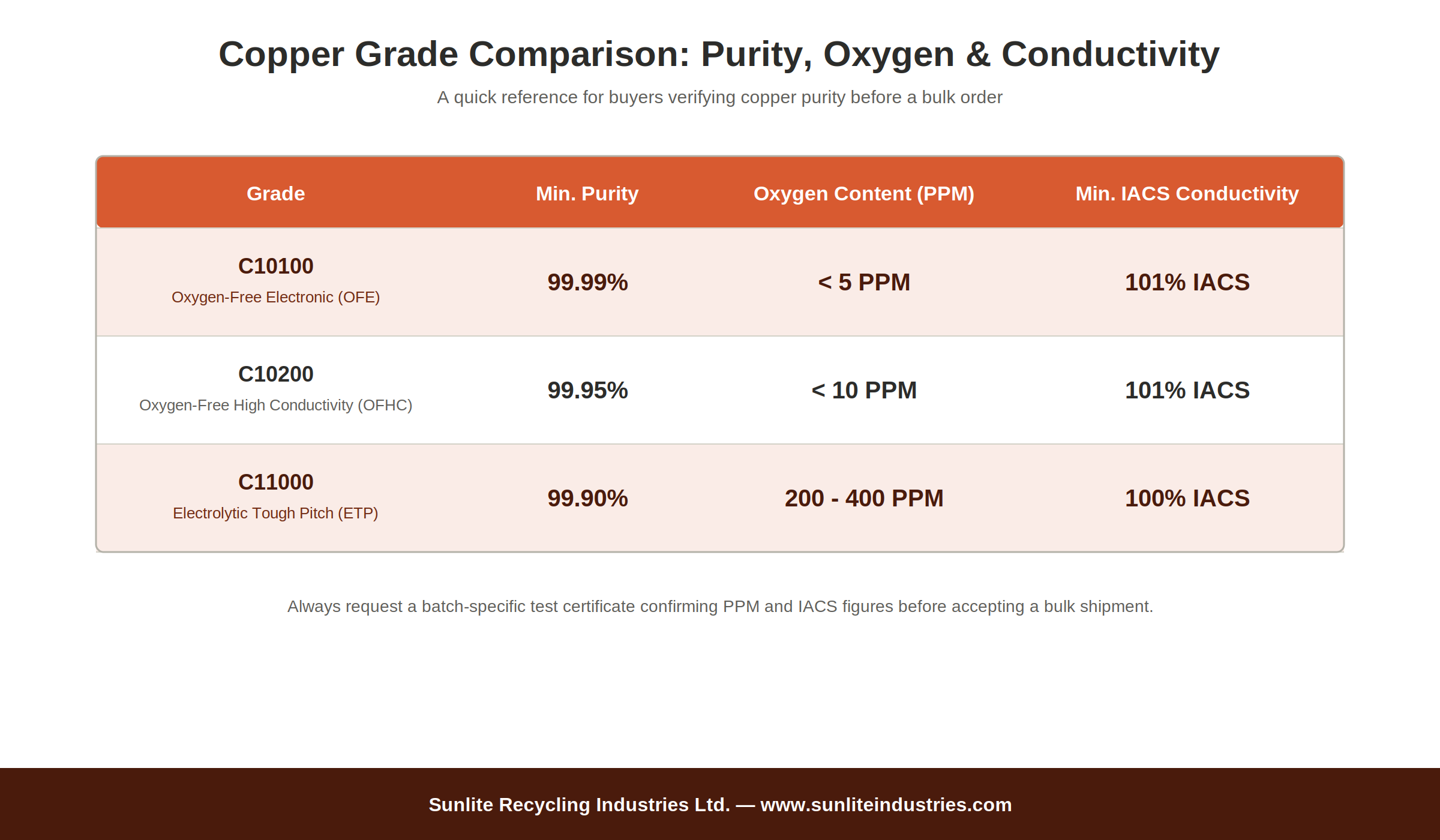
Before you can verify anything, it helps to know what you’re verifying. Indian and international copper grades follow a few common standards:
The oxygen content is measured in PPM (parts per million), and this single number tells you a lot. Oxygen-free copper rods sit under 10 PPM. Once you cross into higher PPM ranges, you start seeing brittleness at high temperatures and a real drop in conductivity — not something you want to discover after the copper’s already wound into a coil.
If a supplier quotes you a grade without a PPM figure or an IACS conductivity rating attached, that’s your first flag. Ask for the number, not just the name of the grade.
Every legitimate copper manufacturer should be able to hand you a Test Certificate (TC) or Certificate of Conformance for each batch. This isn’t a formality — it should list the actual chemical composition (copper content, oxygen PPM, and trace elements like sulfur, lead, or bismuth), the conductivity rating, and which standard it was tested against (ASTM B187, DIN 2.0040, or equivalent). If a supplier is slow to produce this, or gives you a generic certificate that isn’t tied to your specific batch number, don’t treat it as proof — treat it as a reason to ask more questions.
This sounds obvious, but it’s the step most buyers skip. A test certificate for “typical output” or “representative sample” is not the same as a certificate for the actual coil or rod you’re receiving. Copper composition can vary slightly batch to batch depending on the scrap or cathode feedstock used, so match the numbers to your lot.
For any order above a certain volume, it’s worth the small cost of running a sample through independent spectrometric analysis — an optical emission spectrometer gives you the full elemental breakdown, not just “it’s copper.” Some manufacturers run this in-house as part of standard quality and accreditation checks; our own lab, for instance, runs every batch through an oxygen analyser to check PPM levels alongside a spectrometer to verify metallurgical composition, both housed on-site with the production line. If your supplier has this equipment in-house, ask to see a batch report from it. If they don’t, that’s not automatically disqualifying, but it does mean you should budget for third-party testing yourself.
Purity and conductivity move together but aren’t identical. A rod can technically meet a purity percentage while falling short on IACS conductivity if trace elements like phosphorus (used in some deoxidized grades) are present. If conductivity is critical for your application, ask specifically for the IACS% figure, not just the copper content percentage.
This won’t replace lab testing, but it’s a fast sanity check. Genuine high-purity copper has a consistent, bright reddish-orange color across the cross-section, not just the surface. A bend test should show ductility without cracking — brittleness at the bend point often points to excess oxygen or contamination. None of this proves purity on its own, but inconsistency here is a reason to hold the shipment and test before it goes into production.
This one gets skipped a lot, but it matters. Copper made from well-sorted, traceable scrap or cathode tends to have more consistent composition than copper made from mixed, poorly-graded scrap. You don’t need a full supply chain audit, but a manufacturer who can walk you through their copper scrap import and sourcing process in some detail is generally one who’s paying attention to input quality — and input quality is where purity problems usually start. It’s also worth asking how sourcing choices tie into their broader sustainability practices, since responsible scrap sourcing and consistent purity tend to go hand in hand.
“Premium quality,” “superior grade,” “high conductivity” — these phrases mean nothing without numbers attached. Any supplier confident in their product will give you PPM, IACS%, and standard compliance without you having to ask twice. If you’re getting adjectives instead of numbers, push for the data sheet.
None of these steps takes long individually, but together they close the gap between what a supplier claims and what actually shows up at your dock. For high-volume electrical or industrial buyers, that gap is exactly where costly failures hide.
What PPM oxygen content counts as “oxygen-free” copper? Generally under 10 PPM, though true OFE grades like C10100 target under 5 PPM. Anything meaningfully higher shouldn’t be marketed as oxygen-free, even if it’s still reasonably pure.
Can I trust a supplier’s test certificate without independent testing? For smaller or repeat orders with an established supplier, usually yes. For large first-time bulk orders, it’s worth the cost of an independent sample test — it’s cheap insurance against a batch that doesn’t perform as promised.
What’s the difference between purity percentage and IACS conductivity? Purity percentage tells you how much of the material is copper by mass. IACS conductivity tells you how well it actually conducts electricity relative to a standard. They’re related but not interchangeable, and applications sensitive to electrical performance should always ask for both.
Does copper purity affect corrosion resistance too? Yes. Higher-purity copper generally resists oxidation and environmental corrosion better than copper with higher trace-element content, which matters for earthing wire and submersible wire installations exposed to moisture over years.