-

Survey No. 270A & Plot No. 1 of Survey No. 267, Chhatha Mile, Vill: Dantali – 387350 Ta: Vaso, Dist: Kheda, Gujarat (India)
-

Survey No. 270A & Plot No. 1 of Survey No. 267, Chhatha Mile, Vill: Dantali – 387350 Ta: Vaso, Dist: Kheda, Gujarat (India)
The country is gradually shifting from its copper-based telecommunication systems to optical fiber technology. The rationale is obvious: fiber optics provide more bandwidth and data transfer capabilities and have the capacity to accommodate the increasing number of connections for households, companies, and infrastructure.
However, there is another aspect of this shift that does not receive much attention: what becomes of the copper wires that are being substituted?
This is important considering that copper manufacturing in India is not limited to telecommunications. Copper is still essential for the power sector, electric cars, renewable energy production, electrical equipment, and industries.
Why Is Copper Being Replaced by Optical Fiber?
Copper has formed the core of telecommunications infrastructure for many years now. However, the needs of today’s telecommunication systems require carrying much more data, over larger distances, and at faster speeds.
Fiber optics are ideal for this purpose. They can transmit data using light instead of electricity. They have high bandwidth capacity and are ideal for today’s broadband telecommunication systems.
Thus, with the development of India’s digital infrastructure, telecom companies are replacing their copper infrastructure with fiber.
This poses an easy yet fundamental question of what happens to all that copper.
The answer begins with copper cable recycling.
At Sunlite Recycling Industries, recycled copper is brought back into the manufacturing cycle through controlled processing and advanced production capabilities. The result is copper products designed to meet the requirements of today’s electrical, infrastructure, automotive, and renewable energy industries. Explore Our Copper Products
Old Copper Cables Are Not Just Waste
While a copper cable might be at the end of its lifespan as telecom infrastructure, that doesn’t mean that the copper itself is necessarily at the end of its lifespan.
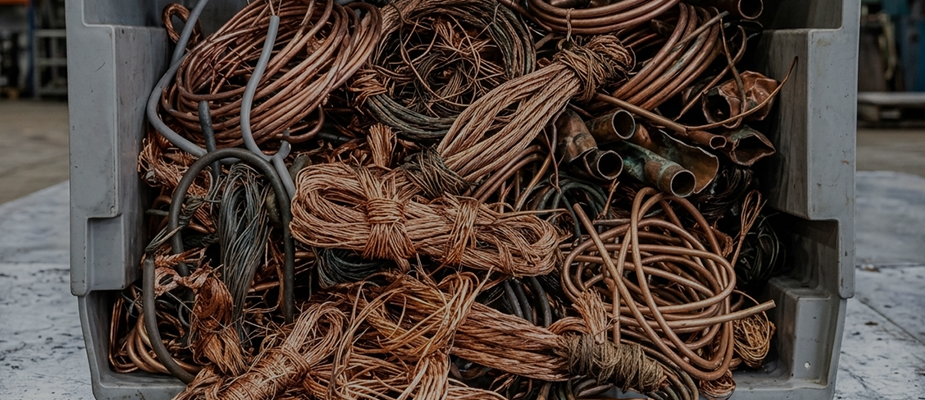
It is possible to gather redundant cables, sort and strip them to separate out the copper contained within them. Copper cable recycling enables this copper to return to the cycle of production rather than become waste.
This is one of the main strengths of copper. The ability to recover and recycle the metal means that a material which has already been extracted and refined can continue to be utilized in other uses.
Fiber optic technology creates another source of recyclable copper.
Copper Demand Is Moving, Not Disappearing
It would be easy to look at the shift from copper to fiber and conclude that copper is becoming less important. The broader picture tells a differen
-t story.
Copper remains central to India’s electrification and infrastructure ambitions. It is used in:
As these sectors expand, so does the need for copper.
So while fiber may replace copper in certain telecommunications applications, other industries continue to increase their dependence on the metal. The result is not necessarily less copper demand. It is copper moving from one application to another.
The Hidden Opportunity in India’s Fiber Transition
The replacement of copper networks with optical fiber creates an interesting connection between telecommunications and recycling.
When redundant copper cables are removed, the recovered material can become part of the secondary copper supply chain. It can then be processed and used in applications completely unrelated to its original purpose.
The journey can look something like this:
Old copper cable → Recovery → Recycling → Copper products → New applications
That circular movement matters at a time when India needs more copper for its energy and infrastructure transition.
For manufacturers, recycled copper can provide an additional source of material while helping keep valuable resources in circulation.
Why Recycled Copper Matters to Manufacturing
Indian copper manufacturing goes beyond having production capacity. Indian manufacturers will also require a dependable source of high-quality raw material and products that are suitable for difficult environments.
Recycling also changes our perception regarding the source of copper. Rather than seeing used cables, electrical scrap, and other discarded copper products as the end of the lifecycle of a product, these materials may become sources for the start of another lifecycle.
This is especially important amid the rising demand for copper in various industries.
For a deeper look at the role recycled copper can play in India’s energy transition, read Why India’s EV Revolution Needs Even More Copper & How Recycled Copper Can Bridge the Gap.
From Old Telecom Cables to New Copper Products
Recovered copper does not necessarily return to telecommunications.
Once appropriately processed, it can ultimately contribute to products serving entirely different industries. Copper’s conductivity, ductility, thermal performance, and recyclability make it valuable across a wide range of applications.
For example, manufacturers of electrical products need copper in forms suited to their specific processes and applications. FRHC copper rods are one such product, widely used in applications including wire and cable manufacturing.
This is what makes the copper-to-fiber transition particularly interesting. The copper may leave the telecom network, but it does not necessarily leave the manufacturing ecosystem.
Looking for a Reliable Recycled Copper Supply?
Sunlite Recycling Industries combines copper recycling with controlled manufacturing processes to produce copper products for electrical, automotive, infrastructure, and renewable energy applications.
Explore Sunlite’s FRHC Copper Rods
What This Means for Copper Manufacturing in India
The shift from copper to optical fiber highlights an important distinction: an application can change without making the underlying material irrelevant.
Telecommunications may need less copper as fiber networks expand. At the same time, India’s growing power infrastructure, EV ecosystem, renewable energy capacity, and industrial base continue to create new demand for the metal.
That makes copper recovery increasingly important.
The copper already embedded in old infrastructure represents a resource that can potentially be recovered and returned to productive use. Connecting that recovered material with modern manufacturing can help create a more circular copper supply chain.
For the copper manufacturing industry in India, the opportunity is not simply to produce more copper. It is also to make better use of the copper that is already in circulation.
Copper May Leave the Network. It Doesn’t Have to Leave the Supply Chain.
Optical fiber may be changing the future of telecommunications, but it does not signal the end of copper.
Old copper cables can become a source of recovered material. That material can move into new applications just as India’s demand for copper continues to grow elsewhere.
The more useful question, then, is not “Will optical fiber replace copper?”
It is: “What can we do with the copper that optical fiber replaces?”
With responsible recovery, recycling, and manufacturing, the answer can be simple: give it another life.
Need Copper for Your Manufacturing Requirements?
From FRHC copper rods to other copper solutions, Sunlite Recycling Industries supports manufacturers looking for consistent, quality copper products.